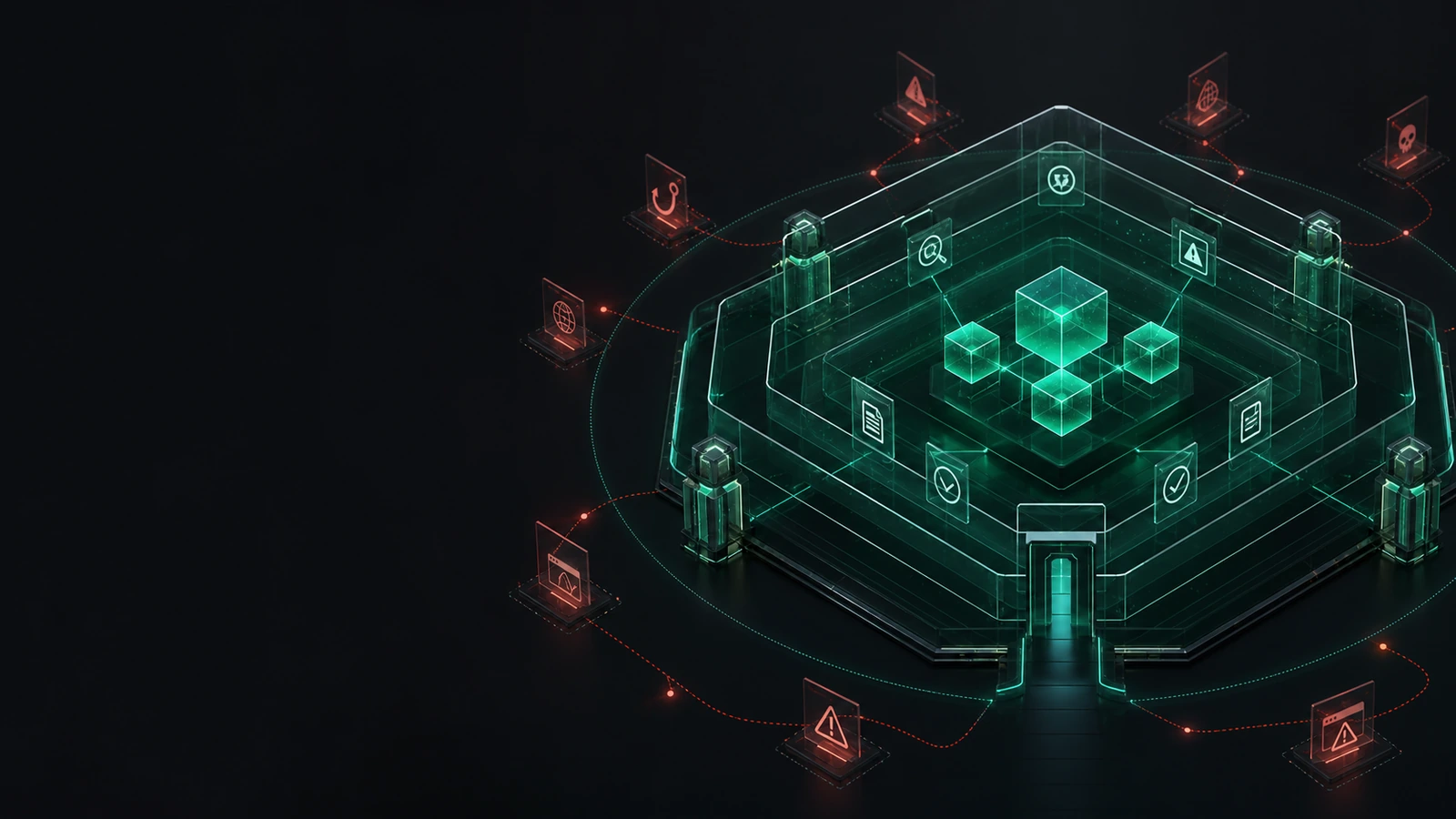
Robinhood Chain uses Ethereum and Arbitrum technology, but that does not make every token, bridge, wallet, or application safe. The most common user risks are fake websites, counterfeit Stock Tokens, malicious approvals, compromised recovery phrases, unaudited contracts, bridge failures, thin liquidity, and impersonated support. Verify the chain ID, domain, full contract address, transaction action, approval amount, and source before signing.
- Security foundation
- Ethereum settlement plus Arbitrum Layer 2 technology
- Sequencer
- Operated by Robinhood; non-custodial according to official terms
- Transaction reversal
- Submitted blockchain transactions generally cannot be cancelled or reversed
- Third-party apps
- Not controlled or guaranteed by Robinhood
- Canonical token check
- Full contract address from official registry
- Primary user secret
- Seed phrase/private keys must never be shared
- Bridge risk
- Varies by canonical or third-party route
- Public activity
- Addresses, transactions, and contracts may be publicly visible
What “safe” can and cannot mean
A network can have strong cryptographic and settlement properties while users still lose assets through phishing, malicious contracts, fake tokens, bridges, poor key management, or market manipulation. Security must be evaluated by layer.
| Layer | Core question |
|---|---|
| Wallet | Who controls the keys and recovery process? |
| Network | Are you on chain ID 4663 using verified endpoints? |
| Token | Is the full contract address canonical? |
| Application | What code and permissions are involved? |
| Bridge | What contracts, validators, solvers, or liquidity providers are trusted? |
| Market | Is there genuine liquidity and reliable pricing? |
| Legal/product | Who is the issuer or counterparty, and are you eligible? |
High-risk patterns to watch for
- Websites impersonating Robinhood, Robinhood Wallet, or Robinhood Chain.
- Tokens using an official-looking name or ticker with a different contract address.
- Fake support agents requesting a password, 2FA code, or recovery phrase.
- Wallet prompts requesting unlimited approvals or unexplained signatures.
- Bridge links reached through sponsored search results or social-media replies.
- Tokens that can be purchased but cannot be sold, or contracts with restrictive transfer logic.
- “Recovery services” requesting wallet credentials or upfront crypto payments.
These are durable risk patterns, not a claim that every example is part of a currently verified Robinhood Chain campaign.
Fake Robinhood websites and support
- Bookmark official documentation rather than relying on ads or direct messages.
- Inspect spelling, subdomains, and certificate warnings.
- Robinhood, Hoodchain.info, wallet support, or a protocol will never need your seed phrase.
- Do not install remote-access software for “wallet recovery.”
- Treat urgent messages about account suspension, airdrop deadlines, or bridge failure as social-engineering signals.
- Never paste a seed phrase into a website to “synchronize” or “validate” a wallet.
Search ads and social posts can lead to cloned interfaces that request a signature or seed phrase. A visually perfect clone can still be malicious.
Airdrop, token, and HOOD confusion
Robinhood Chain uses ETH for gas. No separate official network token or airdrop has been publicly confirmed as of the last review date. A points campaign, streak, quest, or third-party guide does not establish that a future distribution will occur.
HOOD is the Nasdaq ticker for Robinhood Markets, Inc.; it is not the gas token of Robinhood Chain. Tokens using the HOOD name should not be treated as official without a current primary-source contract reference.
Counterfeit Stock Tokens
Permissionless token creation makes ticker symbols unreliable. A counterfeit contract can use AAPL, NVDA, MSFT, or any other familiar label. Robinhood’s official documentation warns that a token with a matching name or ticker but a different contract address is not a Robinhood Stock Token.
- Open the official contract registry.
- Copy the complete address.
- Confirm Robinhood Chain / chain ID 4663.
- Match the address in the explorer and application.
- Check the trading pair and route.
- Do not trust a token because it appeared automatically in a wallet.
New and highly speculative tokens
Robinhood Chain is permissionless, so anyone can deploy a token. Deployment on the network does not mean Robinhood created, reviewed, or endorsed it.
New or thinly traded tokens may have concentrated ownership, unrestricted administrative controls, removable liquidity, blacklist or pause functions, unlimited minting, or transfer rules that make selling difficult or impossible.
- Verify the full contract address.
- Inspect holder concentration and liquidity.
- Check proxy, mint, pause, blacklist, and ownership controls.
- Do not assume legitimacy from a familiar name or website design.
- Avoid treating a successful small purchase as proof that selling will work.
Wallet approvals and signatures
An approval gives a contract permission to move a token. A permit can grant similar authority through a signature. A typed-data signature may look like a login but encode meaningful permissions.
- Read the asset, spender, amount, chain, and expiration.
- Use limited approvals rather than unlimited approvals when practical.
- Do not assume “gasless” means “riskless.”
- Revoke unused approvals after interacting with unfamiliar applications.
- If the seed phrase is exposed, create a new wallet; revoking approvals is not enough.
A simple wallet connection normally does not transfer assets, but later signature prompts can. Separate “connect,” “sign,” “approve,” and “send” in your mental model.
Bridge security
The canonical bridge is designed to inherit its primary security from Ethereum and the Arbitrum system, but still depends on bridge contracts, network operation, and correct user execution. Third-party bridges can add messaging, validators, relayers, liquidity providers, solvers, or aggregators.
- Verify the official route and destination chain.
- Check whether the asset received is canonical, wrapped, or an OFT version.
- Understand withdrawal timing and claim steps.
- Start with a test amount.
- Save transaction hashes.
- Avoid bridges promoted only through social replies or unsolicited messages.
- Do not sign a second “recovery” transaction without understanding the first failure.
Smart-contract and protocol risk
Audits reduce uncertainty but do not prove that a protocol is safe. Audit scope can exclude frontend code, governance, integrations, economic attacks, oracle configuration, or later upgrades.
- Check whether contracts are verified.
- Identify proxy and upgrade mechanisms.
- Review admin, pauser, owner, and multisig privileges.
- Find audit date and exact commit or deployed version.
- Review bug-bounty coverage and incident history.
- Look for emergency withdrawal or pause behavior.
- Consider oracle, liquidity, and liquidation failure modes.
Sequencer, RPC, and availability risk
Robinhood’s terms state that it operates a non-custodial sequencer and provides a public RPC, but does not guarantee continuous uptime, availability, or data completeness. The public RPC may be rate-limited, modified, suspended, or discontinued.
An unavailable interface or RPC does not necessarily mean assets are gone. Use a verified alternative provider or explorer, and avoid entering recovery secrets into a new tool during an outage.
Stock Token product risks
- The token is a debt security issued by RHJ, not the underlying share.
- The holder faces issuer and credit risk in addition to market risk.
- Geographic restrictions can affect acquisition, transfer, and redemption.
- Onchain liquidity can diverge from the underlying market.
- Price feeds and protocol integrations can fail or be misused.
- Corporate-action multipliers must be handled correctly by interfaces and contracts.
A valid canonical Stock Token can still be unsuitable, illiquid, restricted, or exposed to downstream protocol risk. Authenticity is only the first check.
A safe transaction checklist
- Confirm the device and browser are clean and updated.
- Open the site from a saved or primary-source link.
- Confirm chain ID 4663.
- Verify the full token and contract addresses.
- Read the wallet prompt and identify the exact action.
- Limit the approval amount.
- Check recipient, amount, slippage, and expected output.
- Use a small test transaction.
- Verify the result in the explorer.
- Revoke unnecessary permissions and document important transaction hashes.
What to do after a suspicious approval
- Stop interacting with the site.
- Record the transaction hash and spender address.
- Use a trusted approval viewer to identify permissions.
- Revoke malicious approvals if the wallet key is still secure and action is safe.
- Move valuable assets to a fresh wallet if compromise is possible.
- Do not send more funds to “unlock” or “recover” assets.
- Report the malicious domain, contract, and social account to relevant providers.
When a wallet is actively being drained, ordinary manual actions can be front-run by an attacker. Professional incident-response tooling may be required, and recovery is not guaranteed.
What to do if the seed phrase is exposed
Treat the wallet as permanently compromised. Create a new wallet on a trusted device, secure the new recovery information offline, and move assets where feasible. Do not reuse the exposed phrase. Do not type it into a “migration” website. Revoking approvals cannot remove an attacker who has the private key.
Public-chain privacy
Official terms note that addresses, transactions, contracts, and interactions may be publicly visible. Pseudonymous addresses are not necessarily anonymous; exchange deposits, public profiles, domain registrations, and repeated transaction patterns can connect activity to an identity.
- Do not publish wallet screenshots with addresses unless intentional.
- Separate public and private operational wallets where appropriate.
- Assume transaction history can be analyzed indefinitely.
- Do not store sensitive personal information directly onchain.
Current security alerts
Time-sensitive incidents, phishing campaigns, malicious contracts, and urgent response guidance are published in the Security updates section when independently verified. No active official network incident is currently listed by Hoodchain.info; this does not prove that no scams or third-party incidents exist.
Frequently asked questions
Is Robinhood Chain safe to use?
It has an Ethereum Layer 2 security model, but user safety depends on wallets, contracts, bridges, tokens, applications, operational availability, and legal/product risks.
How do I verify a Robinhood Stock Token?
Match the full contract address against Robinhood’s official token-contract registry. The ticker alone is not evidence.
Can Robinhood reverse a blockchain transaction?
Official terms state that the sequencer cannot modify, reverse, or cancel transactions once submitted.
What should I do if I signed a malicious approval?
Stop interacting, identify and revoke the approval if the wallet key is secure, and move assets to a fresh wallet if compromise is possible.
Can support recover my seed phrase?
No legitimate support process requires or can safely use your seed phrase. Anyone requesting it should be treated as an attacker.
Is an audited protocol safe?
An audit is one signal, not a guarantee. Review scope, deployed version, admin controls, integrations, liquidity, incident history, and economic risks.
Primary sources
| Source | Type | Last checked |
|---|---|---|
| Robinhood Chain Terms of Service and risk disclosures | Primary source | 2026-07-12 |
| Canonical Stock Token contracts | Primary source | 2026-07-12 |
| Bridge routes and canonical withdrawal process | Primary source | 2026-07-12 |
| Network endpoints and public-RPC limitations | Primary source | 2026-07-12 |
| Stock Token legal and technical disclosures | Primary source | 2026-07-12 |
Related updates and guides
Explore current reporting and practical guidance related to this topic.