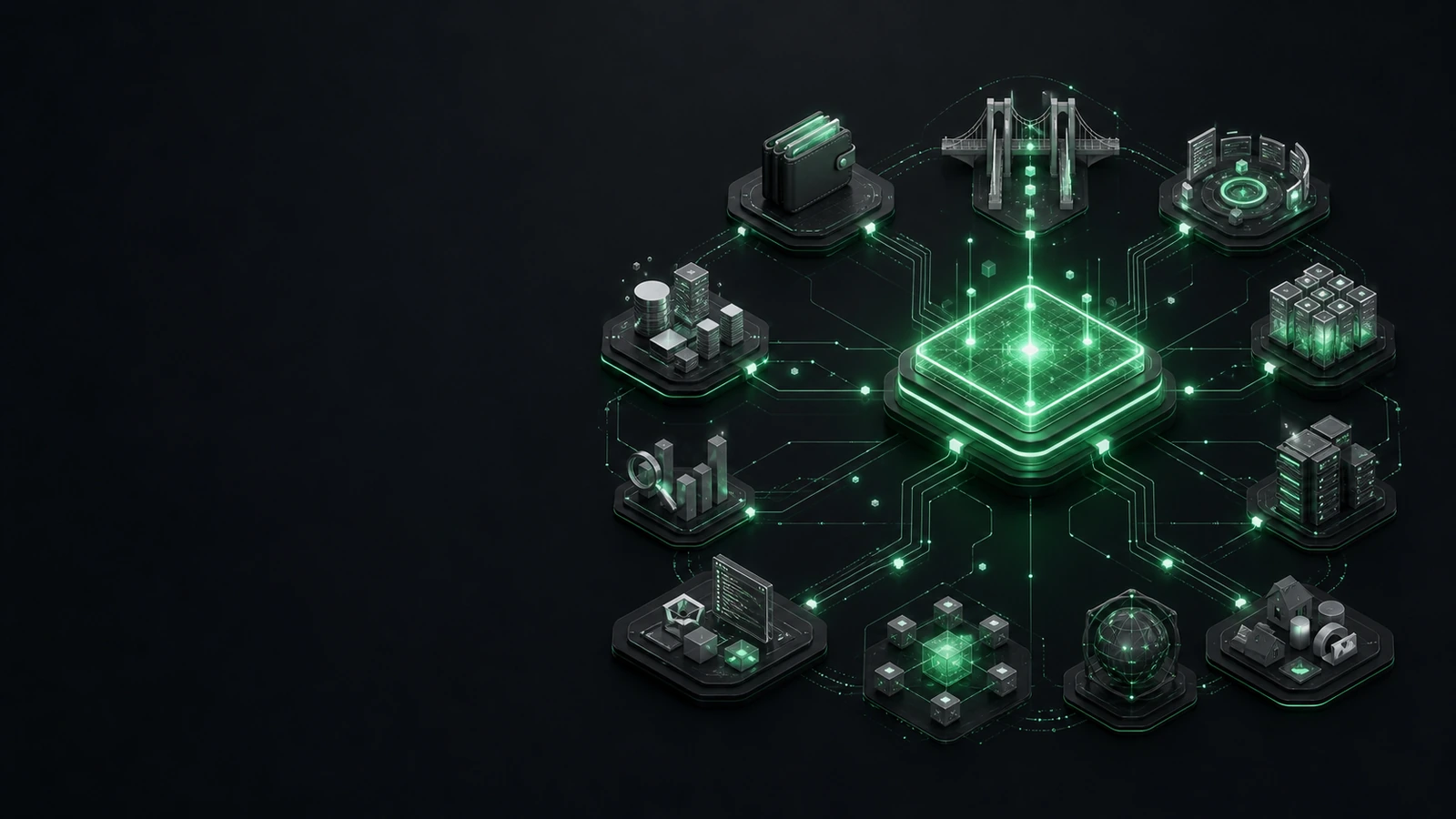
The Robinhood Chain ecosystem includes wallets, bridges, exchanges, lending protocols, perpetual-trading venues, stablecoin infrastructure, oracles, RPC providers, analytics, custody, compliance, and developer tools. Robinhood’s official documentation currently names providers and applications including Alchemy, LayerZero, Chainlink, Fireblocks, BitGo, Allium, CoinGecko, Uniswap, Rialto, Morpho, Lighter, Arcus, Paxos, Zerion, and TRM Labs. Inclusion does not mean Robinhood guarantees the safety or suitability of a third-party protocol.
- Network status
- Public mainnet live
- Application model
- Permissionless third-party deployment
- Core user categories
- Wallets, bridges, trading, lending, analytics
- Core infrastructure
- RPC, oracles, messaging, custody, compliance
- Official listing meaning
- Discovery/support information, not a safety guarantee
- Primary verification
- Official domain, contract, chain, audit, current status
- Chain ID
- 4663
- Gas asset
- ETH
How to read the ecosystem
An ecosystem page should answer two different questions: “What exists?” and “What can be trusted?” The first is a discovery problem. The second requires evidence, and the answer is rarely binary.
Hoodchain.info separates network-level facts, third-party project claims, and independent risk observations. A project can be real but risky; supported but unaudited; audited but illiquid; or technically open while legally unavailable to a user.
Ecosystem categories
| Category | Purpose | Examples named in official documentation |
|---|---|---|
| Wallets and wallet data | Hold assets, connect to applications, display portfolios | Robinhood Wallet, compatible EVM wallets, Zerion data |
| Bridges and messaging | Move assets and messages across networks | Canonical Arbitrum bridge, LayerZero, Chainlink CCIP, Relay, Across, LiFi, 0x |
| Spot trading | Exchange tokens onchain | Uniswap, Rialto |
| Lending | Borrow, lend, and use collateral | Morpho |
| Perpetuals | Leveraged derivative trading | Lighter, Arcus |
| Stablecoins | Settlement and quote assets | Paxos / USDG |
| RPC and account abstraction | Application connectivity and programmable wallets | Alchemy and other providers |
| Oracles | Onchain market data | Chainlink |
| Analytics and tracking | Network, token, and portfolio information | Allium, CoinGecko |
| Institutional custody | Operational asset custody | Fireblocks, BitGo |
| Compliance and risk | Screening and blockchain intelligence | TRM Labs |
Wallets
A wallet is the user’s access layer, not a guarantee of every token or application displayed inside it. Robinhood Wallet supports Robinhood Chain, and standard EVM wallets can add the network manually.
- Check whether the wallet is custodial, self-custodial, smart-contract based, or account-abstraction based.
- Understand recovery, backup, and device-loss procedures.
- Confirm the wallet supports custom tokens and the correct explorer.
- Treat in-wallet discovery lists as convenience, not independent due diligence.
Bridges
Bridges connect Robinhood Chain to other networks. The canonical bridge is the default Ethereum-to-Robinhood route and inherits its core security model from Ethereum and Arbitrum contracts, while partner routes optimize for speed, coverage, or composability.
- Canonical bridge: slower withdrawals but fewer third-party validation assumptions.
- Messaging and OFT routes: support cross-chain token designs and programmable transfers.
- Intent-based bridges: use solvers or liquidity providers for fast execution.
- Aggregators: search across routes and can combine swaps with bridging.
Bridge choice should reflect value, urgency, source chain, asset support, contract risk, liquidity, fees, and recovery options—not only quoted speed.
Trading applications
Public exchanges allow users to trade assets without a traditional order-routing account. Uniswap is named as a public DEX supporting the network, and other venue types may include automated market makers, proprietary-liquidity systems, or aggregators.
- Verify the token contract and trading pair.
- Check liquidity depth, price impact, and route.
- Do not interpret high volume as proof of quality or legitimacy.
- Understand that permissionless markets can list counterfeit or highly speculative tokens.
- Review approval amounts before trading.
Lending and collateral
Lending protocols can allow users to supply assets, borrow against collateral, or integrate tokenized real-world assets into credit markets. Morpho is listed in official ecosystem documentation.
A lending position adds liquidation thresholds, oracle dependencies, interest-rate changes, collateral concentration, market-liquidity risk, and protocol governance risk. A Stock Token accepted as collateral does not become a traditional brokerage asset.
Oracles and market data
Chainlink provides price feeds and cross-chain infrastructure in the documented ecosystem. Price feeds let smart contracts read reference data, which is essential for Stock Token applications, lending, liquidations, and structured products.
An oracle feed is one component. Applications must select the correct feed, account for decimals and multipliers, handle stale data, and design circuit breakers. End users still face venue pricing and contract-integration risk.
Infrastructure for developers
- RPC providers connect applications to blockchain nodes.
- Data APIs index balances, transactions, NFTs, and portfolio activity.
- Account abstraction can support gas sponsorship, batching, spending policies, and session keys.
- Cross-chain messaging allows actions across multiple networks.
- Full nodes provide greater independence but require substantial hardware and operations.
- Explorers help inspect contracts, addresses, events, and transactions.
Official documentation recommends provider infrastructure for production because the public RPC is rate-limited and can be modified or unavailable.
Permissionless deployment does not mean endorsement
Anyone may be able to deploy a token or application on a permissionless network. Presence on Robinhood Chain does not mean Robinhood created, audited, approved, or recommends the project.
Hoodchain.info does not present unverified speculative tokens as established ecosystem projects. Project profiles distinguish deployment, integration, official documentation references, audit evidence, operational status, and independent verification.
How Hoodchain.info evaluates projects
| Signal | What each review records |
|---|---|
| Identity | Official domain, organization, public team or accountable entity |
| Deployment | Verified Robinhood Chain contract addresses |
| Status | Announced, testnet, mainnet, paused, deprecated, or inactive |
| Function | Wallet, bridge, DEX, lending, oracle, analytics, infrastructure, other |
| Custody | Who controls keys or assets |
| Audits | Auditor, date, scope, version, and unresolved findings |
| Admin controls | Upgradeability, pausing, privileged roles, multisig |
| Liquidity | Relevant depth and concentration, not only headline TVL |
| Legal access | Known restrictions and required accounts or checks |
| Incidents | Exploits, pauses, insolvencies, migrations, or material warnings |
| Review date | When Hoodchain.info last rechecked the information |
Official, integrated, listed, and endorsed are different
A provider can support Robinhood Chain technically without being operated by Robinhood. A project can appear in official documentation without Robinhood guaranteeing its safety. Robinhood explicitly states that third-party inclusion is not an endorsement, sponsorship, affiliation, or warranty.
Every Hoodchain.info profile preserves that distinction. An official-logo collage is not used as a substitute for project-level verification.
What to monitor as the ecosystem matures
- Sustained active addresses rather than launch spikes.
- Stablecoin and bridge liquidity.
- Stock Token usage beyond simple transfers.
- Lending utilization and liquidation behavior.
- Application revenue and organic retention.
- Security incidents and upgrade quality.
- Developer deployment and tooling depth.
- Concentration among a small number of apps or speculative assets.
- Geographic availability and regulatory clarity.
Frequently asked questions
What apps are on Robinhood Chain?
Official documentation lists infrastructure and applications across wallets, bridges, trading, lending, perpetuals, oracles, analytics, stablecoins, custody, and compliance. The set is expected to change.
Is every project listed by Robinhood safe?
No. Robinhood explicitly says third-party inclusion does not constitute endorsement or a warranty of safety, legitimacy, or suitability.
Which wallet supports Robinhood Chain?
Robinhood Wallet supports the chain, and compatible EVM wallets can add it using the official network configuration.
Which DEX supports Robinhood Chain?
Uniswap is named as a public DEX in official ecosystem documentation. Users should verify the current deployment and token contracts.
Can Stock Tokens be used in DeFi?
Their ERC-20 structure and price feeds allow integration, but each protocol introduces additional smart-contract, liquidity, oracle, liquidation, and legal risks.
How does Hoodchain.info decide which projects to include?
Projects must have verifiable relevance to Robinhood Chain. Reviews record status, contracts, custody, audits, administrative controls, risks, sources, and review dates.
Primary sources
| Source | Type | Last checked |
|---|---|---|
| Robinhood Chain documentation and ecosystem list | Primary source | 2026-07-12 |
| Robinhood Chain bridging routes | Primary source | 2026-07-12 |
| Network and infrastructure providers | Primary source | 2026-07-12 |
| Third-party and network risk disclosures | Primary source | 2026-07-12 |
Related updates and guides
Explore current reporting and practical guidance related to this topic.